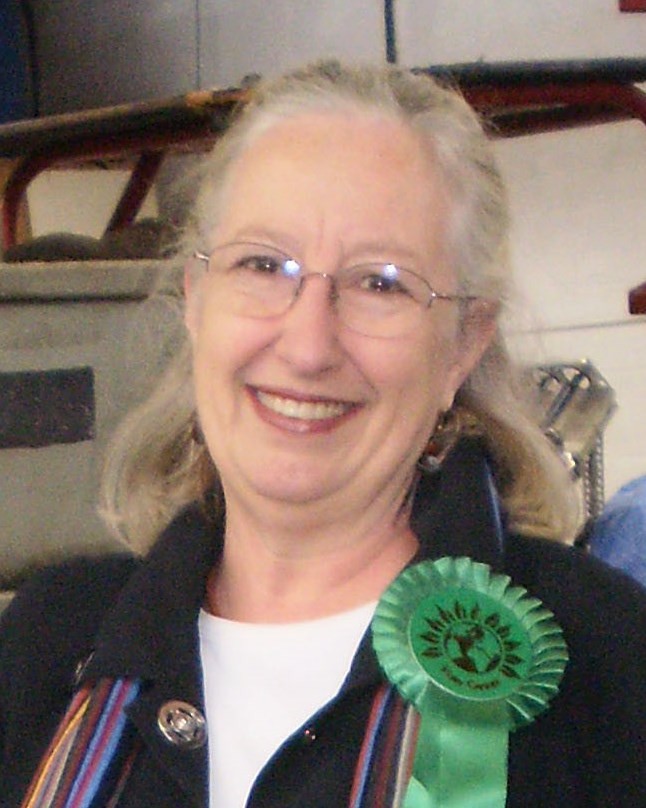
Pete McAskie (pictured), the Green Party Parliamentary candidate for Hornsey and Wood Green constituency, spoke at the recent Muswell Hill General Election Hustings at the British Legion, Muswell Hill Road. The event was organised by Friends of the Earth and Highgate Pensioners Association. This is an edited version of what Pete said to the meeting.
We need a more equal society, action on climate change, cut wars, Trident and ID cards, not public services.
Like the Government, we aim to more than halve deficit by 2013.
Our financial system is out of all proportion to the real economy beneath it, and we have lost touch with our environmental underpinnings. Casino capitalism has taken over with the impossible goal of limitless growth. It is a dangerous and careless fantasy. Social mobility has declined and inequality has risen over the past thirty years. Inequality makes us ill, increases crime, creates stress & much more. We may be much richer than in 1950, but we are no happier.
The financial sector needs much more regulation and there should be a tax, a permanent tax on bankers’ bonuses. Income tax should be at 50% on incomes over £100,000. A National Min Wage of £8.10 should be introduced which will save up to £6bn a year in tax credits, Council Tax and Housing Benefits.
We propose the Green New Deal. A £44bn investment priority to create one million jobs/training places through investment in renewable energy, public transport, insulation, social housing & waste management. This promises job security and economic stability.
By contrast, Labour’s “green” new deal is for modest £100m less than one twentieth of the subsidy for the motor industry, and the Lib Dems offer only £3bn for their version.
On Housing we would provide £4bn a year to local authorities for social housing, mainly conversion/renovation yielding 80,000 jobs across the country. There are one million empty homes in the UK. Half this number through empty property use orders. To relieve pressure on housing in the South East of England we would see development spread more evenly around the country. Incentives should be made available to create a million solar roofs per year, a free home insultation programme for four million homes a year & raise energy standards in building regulations, including embodied energy building materials.
We aim to protect public services. They are the foundation of an equitable society, and should be publicly owned, publicly funded and publicly accountable. We propose a 50% increase in Carer’s Allowance and an increase in respite breaks. Not only is this fair, but carer’s actually save the state £87 billion a year, by carrying out their vital work. We will also phase in free care for the elderly.
In schools, we will recruit more teachers so that average class sizes are brought down to twenty, which is, after all, only the EU average. We will phase in the abolition of tuition fees at Universities, and phase out City Academies. The SATS school testing regime will be scrapped and wholesome, free school meals will be available to all school children.
We think that the present general election system is unfair. It’s unfair that 200,000 voters in marginal constituencies effectively decide an election for a voting population of over 40 million. We would introduce the proportional Additional Member system.
And of course, the environment. Miners used to take canaries down mines with them to check for poisonous gases. That’s what climate change is today. A warning of more general ecological collapse. Evidence from Copenhagen showed that government’s haven’t grasped scale of change needed.
Our lifestyle depends on burning fossil fuels. We are addicted to it and vulnerable to fluctuations in its market especially the approaching peak oil scenario. Nuclear is not the answer, it too depends on dwindling uranium deposits, and does produce radioactive waste, and there is the danger from leaks and the chance of a major disaster. There is still a lot of coal around, but this is even worse than oil for carbon and other emissions.
We need a more decentralised energy system using micro generation and local distribution networks, saving energy lost now in transmission. Together, with a massive investment in green energy projects, (wind, wave and solar) with a nationwide insulation scheme, and increases in public transport, all creating over one million new jobs.
Expansion of public transport, walking and cycling is critical to decarbonising our transport infrastructure. The only sector in which emissions are still rising. The £30 billion allocated to road building, we'll switch to public transport. We'll also put an extra £1.5 billion in to make fares up to 10% cheaper. Return the railways & tube to public ownership, stop airport expansion and introduce VAT and fuel duty to the aviation industry, raising £10bn a year.
Internationally, we favour the introduction of the Tobin Tax, (sometimes now referred to as the Robin Hood Tax), which taxes international financial transactions and redistributes the money to green energy projects and to developing countries so that they can grow sustainably out of poverty.
We need to stop engaging in foreign wars. In Afghanistan, the best way forward is to call a regional peace conference involving the Afghan people and countries in the region, with a view to exiting our armed forces as soon as is possible. We should also stop subsidising the arms trade and get rid of our nuclear weapons.
So, our vision is of a fairer society and an economy working with nature rather than against it. Vote Green on 6th May